
Shadowing Senior Engineers
I’m Bryan, a process engineer who’s spent the past two years at Lutra learning under the guidance of senior engineers. I’d like to share the lessons I’ve learned whilst observing senior engineers in the field and the office.
Socialising for Work
"Great social skills" is probably one of the most common strengths listed on a fresh graduate's CV, yet there's no real benchmark for what it means. Within my own experience, socialising in school and university settings is significantly easier than at work; within those settings, everyone is roughly the same age, studying similar topics and stuck in the same lecture theatres, so conversation comes naturally. On site, you’re talking to operators who’ve been running plants for years, council staff juggling a dozen other projects, and contractors who aren’t always interested in chatting. Socialising for work means earning the trust of people who owe you nothing.[GU1]
Observing my seniors showed me what that looks like in practice. I remember attending a site visit with a senior who was able to convince operators and council staff to bend over backwards to find drawings and documentation of underground pipework dating back to the 1970s. That didn’t come from a single phone call; it came from years of remembering names, asking about the operators’ day, and treating their knowledge of the plant as just as valuable as any drawing.
Indiana Jones-esque Exploration
I will admit my initial impression of the field of engineering was that it was primarily desk-based. However, site visits with senior engineers really changed that perspective.
Recalling the first few site visits I did, I remember working on a Piping & Instrumentation Diagram (P&ID) project for a district council’s water treatment plant. I was walking around the plant with a senior engineer, holding a clipboard with printouts of the plant’s as-built drawings. It was initially a bit of a struggle for me to identify the location of the equipment and pipework. The senior engineer I was with explained to me that some things that were depicted on paper weren’t always present; sometimes it’s because the plant had been upgraded since the drawings were made, sometimes pipes and ducts ran through walls or ceilings where they couldn't be seen, and sometimes the person who drafted the last as-built had simply missed them.
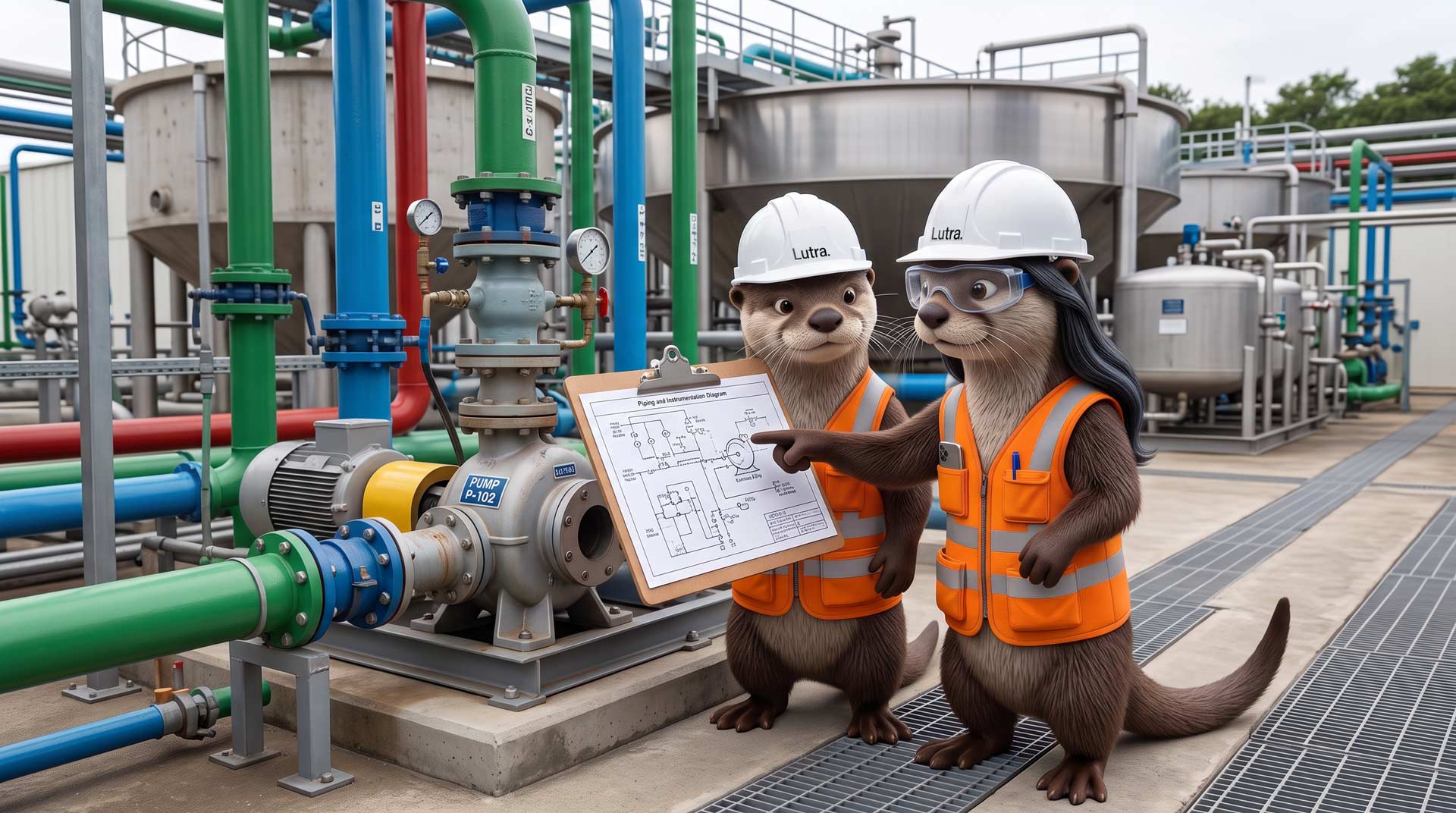
Both water and wastewater treatment plants contain their fair share of hazards and obstacles, requiring high levels of alertness for safe exploration. Sometimes, important components are kept behind heavy rusted doors or under insect-ridden boards. Watching senior engineers react to these on-site hurdles taught me the importance of spatial awareness, physical fitness and reading a site as it really is rather than as it's drawn. It also taught me to get over my fear of insects "Water Plant” based Anatomy.
Back in university, we were taught each unit operation separately; clarification had its own chapter, filtration had its own chapter, and so on. Walking around a plant with a senior was a different experience entirely. The seniors I’ve shadowed tend to view a plant as a living organism, where each process is an organ that relies on the one before it. For example, a change in raw water turbidity at the intake can show up as a dosing problem at the flocculators, resulting in a dirtier filter, and the operators complaining about how often they need to backwash.
Since then, I’ve picked up the habit of following the flow the way my seniors do; starting at the inlet, walking it through to the outlet, and asking myself what each step is protecting the next one from.
Lessons on Temperance and Moderation
Working on live plants doesn’t always go to plan. During my time at Lutra, I’ve seen and heard of equipment arriving late, site visits getting cancelled due to poorscheduling, or clients changing the scope halfway through a design. What stood out to me was how calm my seniors were whenever these things happened.
I’ve noticed that this kind of composure goes a long way with clients and operators. When the project lead stays level-headed, everyone else tends to follow suit. I’ll admit I’m still working on this one myself, but I’ve learned that taking a pause before replying to a tense email is always worth it.
That same temperance applies to how my seniors manage their own time and energy. As a junior, I found it tempting to say yes to everything and stay late to prove myself. The seniors I’ve worked with are some of the hardest-working people I know, but they’re also quite deliberate about switching off. Whether it’s heading out for a tramp on the weekend, spending time with friends and family, or simply leaving on time, they treat rest as part of doing the job well rather than a reward for finishing it. Observing this taught me that keeping a sustainable pace is what lets you stay sharp in the long run, both on site and in the office.
Final Words
Looking back on my first 2 years, the biggest lesson I’ve learned is that the technical side is only half the job. To any fresh grads reading this, my advice would be to tag along on as many site visits as you can, ask plenty of questions, and pay attention to how your seniors work, not just what they know.